
Agile Estimation Techniques: Which One Actually Works?
Agile estimation has a reputation for being… messy.
Some teams estimate in hours and argue for 45 minutes. Others use story points and still miss deadlines. And plenty of teams quietly skip estimation altogether—then wonder why planning feels chaotic.
The truth is: there isn’t one perfect estimation method. But there are techniques that work consistently—if you match them to the type of work you do and the level of uncertainty you face.
This guide breaks down the most practical Agile estimation techniques, what they’re best for, and how to pick a system that improves predictability without turning estimation into a time sink.
What “works” in Agile estimation (and what doesn’t)
Before picking a technique, define what you want estimation to achieve:
- Planning: “How much can we realistically deliver this sprint?”
- Forecasting: “When will this feature / project likely be done?”
- Coordination: “What is big, risky, or needs breaking down?”
- Tradeoffs: “What can we cut or simplify to hit a target date?”
What doesn’t work:
- Forcing precision when uncertainty is high
- Using estimation to judge or pressure people
- Estimating every tiny task with the same effort
- Treating estimates as commitments instead of probabilities
If your team debates the difference between “5 hours” and “6 hours,” you’re not estimating—you’re negotiating.
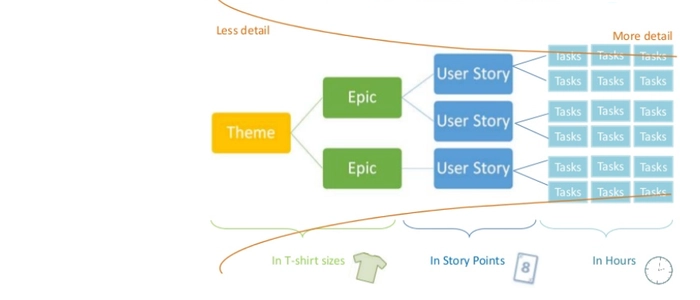
Technique #1: Story points (relative estimation)
Story points estimate relative effort, not time. You compare work items to each other and ask: “Is this smaller, similar, or larger than that?”
Why story points work
- They avoid false precision (especially early on)
- They incorporate complexity, uncertainty, and effort
- They become more accurate as the team learns patterns
When story points fail
- Teams convert points to hours (“1 point = 4 hours”) and lose the benefit
- Points become performance metrics for individuals
- Work items are too large or poorly defined
Story points are the most common Agile approach for good reason—but only if you keep them relative.
If you want a direct comparison, read: Story Points vs Hours: Which Should Your Team Use?.
Technique #2: Planning Poker (consensus estimation)
Planning Poker is a group technique (often paired with story points). Everyone privately selects a number (commonly Fibonacci-like: 1, 2, 3, 5, 8, 13…), reveals at the same time, and discusses differences.
Why it works
- Prevents anchoring (no one sees another estimate first)
- Surfaces hidden assumptions quickly
- Builds shared understanding of the work
How to run it fast
- Timebox each story (e.g., 2–4 minutes)
- If estimates are close, don’t debate—pick the higher one
- If estimates are far apart, ask: “What assumption is different?”
- Break down anything that jumps to 13+ points
Planning Poker “works” when your goal is alignment as much as estimation.
Technique #3: T-shirt sizing (S/M/L/XL)
T-shirt sizing is a quick, low-effort technique for early-stage planning. You classify items as Small, Medium, Large, etc.
Best for
- Roadmaps and early product planning
- Backlog triage (what needs splitting?)
- High-uncertainty work
Not great for
- Sprint-level commitment (too coarse)
- Teams that need detailed forecasting
A strong pattern: use T-shirt sizing in discovery, then convert the short-list into story points once work is clearer.
Technique #4: Ideal days (or “perfect day” estimates)
Ideal days estimate how long something would take with no interruptions, waiting, meetings, or surprises.
Pros
- Helpful for communicating uncertainty (“ideal vs real”)
- Good for tasks with repeatable, known steps
Cons
- Still feels like time estimation—invites false precision
- Often ignored when reality hits (dependencies, reviews, rework)
If your work includes a lot of waiting and handoffs, forecasting with flow metrics usually beats ideal days.
Technique #5: Affinity mapping (fast group estimation)
Affinity estimation is a rapid way to estimate a large backlog.
How it works:
- Place a “reference story” on the board
- As a group, sort other items into piles that feel similar in size
- Assign point values to each pile
- Only discuss the outliers
This technique works great when you have 30–100 items and need a fast “good enough” sizing pass.
Technique #6: No estimates (forecasting with throughput)
Some teams move away from estimating each item and instead forecast using historical throughput (how many items they typically finish per time period).
This approach works best when:
- Work items are similar in size (or you actively split them)
- You track completion consistently
- You care more about predictability than precision per task
To make this work, your backlog needs strong slicing discipline. If items vary wildly, “no estimates” becomes “no visibility.”
If you’re mixing Scrum-style planning with flow thinking, it helps to understand how outcome metrics differ. See: Velocity vs Throughput: Why These Metrics Are Not the Same.
So… which Agile estimation technique actually works?
Here’s a practical decision guide:
- For sprint planning + alignment: Story points + Planning Poker
- For roadmap sizing (early uncertainty): T-shirt sizing
- For large backlogs quickly: Affinity mapping
- For repeatable operational tasks: Ideal days (lightly)
- For mature flow teams with consistent slicing: Throughput-based forecasting (light estimates)
If you’re just starting: Story points + Planning Poker is the most reliable default for most Scrum teams.
3 rules that make any technique work better
1) Break work down until it’s predictable
Estimation quality is mostly a function of how well you slice work. If items are too big, every method fails.
2) Estimate for the team, not the individual
Agile estimation is about system predictability. Avoid comparing people or “measuring productivity” via estimates.
3) Use estimates to learn, not to punish
When something takes longer than expected, ask:
- What assumption was wrong?
- What risk wasn’t visible?
- How can we split or clarify work next time?
That’s how estimation improves instead of becoming a morale killer.
Final Thoughts
The best Agile estimation technique is the one that helps your team make better decisions with the least friction.
If you want a clean, highly visible way to run estimation and planning discussions, a physical board setup makes a huge difference—especially when you’re aligning on what “small vs large” looks like together.
Related reading:
- Story Points vs Hours: Which Should Your Team Use?
- Velocity vs Throughput: Why These Metrics Are Not the Same
Note: Your “Internal Links (Same Category)” list contained Visual/Work Visualization links (Visual PM topics). I kept them out of this Scrum-focused article and used the provided cross-category links that fit estimation best.