
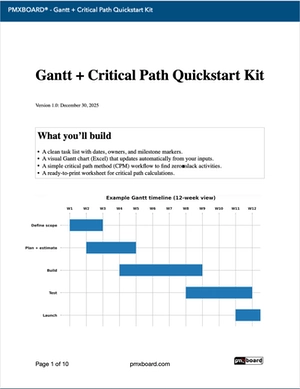
Critical Path Example (CPM): Find the True Finish Date in 10 Minutes
If your project schedule keeps slipping, the problem is usually not “effort”—it’s dependencies. A simple Critical Path Method (CPM) pass helps you see which tasks actually control the finish date.
Below is a practical critical path example you can copy into your next plan—plus a free kit to build a clean Gantt and CPM worksheet in minutes.
What “critical path” actually means (plain English)
The critical path is the longest chain of dependent work from start to finish. Tasks on this path have zero float (no schedule slack). If any of them slip, the whole project finish date moves.
A simple critical path example (6 tasks)
Here’s a small project with durations and dependencies. Copy this structure for any workstream (software, operations, launches, Kaizen, etc.).
| Task | Duration (days) | Depends on | Notes |
|---|---|---|---|
| A — Define scope | 2 | — | Start task |
| B — Requirements | 4 | A | Needs scope baseline |
| C — Design | 3 | B | Based on requirements |
| D — Build | 6 | C | Execution work |
| E — Test | 3 | D | Quality gate |
| F — Launch | 1 | E | Release / deploy |
Step-by-step: how to find the critical path
Because the work is a straight dependency chain (A → B → C → D → E → F), the critical path is the entire chain. Total duration = 2 + 4 + 3 + 6 + 3 + 1 = 19 days. In real projects you’ll typically have parallel branches—CPM tells you which branch is the one that truly controls the finish.
5 common critical path mistakes (and how to avoid them)
- Missing dependencies: If a task “must follow” another task, model it. Don’t rely on memory.
- Overly large tasks: Break anything longer than 5–10 working days into smaller parts.
- Ignoring calendars: Holidays, resource availability, and review windows change the real finish date.
- Confusing effort with duration: Duration is calendar time; effort is work time. They aren’t the same.
- Never updating the plan: CPM is not “set-and-forget.” Update weekly so the true critical path stays visible.