
What Is Kaizen? A Beginner’s Guide to Continuous Improvement
Kaizen is one of the most powerful — and misunderstood — improvement concepts in modern work.
If you’ve ever wondered what is Kaizen, the simple answer is this: Kaizen is a mindset of continuous, incremental improvement driven by the people who do the work.
It’s not a tool. It’s not a one-time workshop. And it’s not reserved for manufacturing. Kaizen is a way of thinking that helps teams improve processes, solve problems, and build better systems every single day.
What Does Kaizen Mean?
The word Kaizen comes from Japanese:
- Kai = change
- Zen = good or better
Together, Kaizen means change for the better.
In practice, Kaizen focuses on small, frequent improvements rather than big, disruptive changes. The idea is simple: many small improvements over time create massive long-term results.
What Is Kaizen in Practice?
Kaizen shows up in daily work as:
- Identifying problems as they occur
- Fixing root causes instead of symptoms
- Improving processes step by step
- Involving everyone, not just managers
Rather than relying on top-down directives, Kaizen empowers teams to improve their own work continuously.
Kaizen vs Lean: How They Relate
Kaizen is often discussed alongside Lean — but they are not the same.
Lean is the broader system focused on maximizing customer value and minimizing waste.
Kaizen is the mechanism that drives improvement within that system.
A helpful way to think about it:
- Lean defines where to go
- Kaizen defines how you improve to get there
For a deeper comparison, see: Kaizen vs Lean: What’s the Difference?
Kaizen Events vs Daily Kaizen
Kaizen can happen in two main ways:
Kaizen Events
Kaizen events are focused, short-term improvement workshops where a team works intensively on a specific problem or process.
They are useful for:
- Breaking through stubborn problems
- Redesigning workflows
- Jump-starting improvement momentum
Learn how they work here: How to Run a Kaizen Event (Step-by-Step Playbook)
Daily Kaizen
Daily Kaizen is where real transformation happens.
It focuses on:
- Small improvements made every day
- Encouraging problem-solving habits
- Embedding improvement into normal work
This comparison explains the difference clearly: Kaizen Events vs Daily Kaizen: What’s the Difference?
The PDCA Cycle: Kaizen’s Core Engine
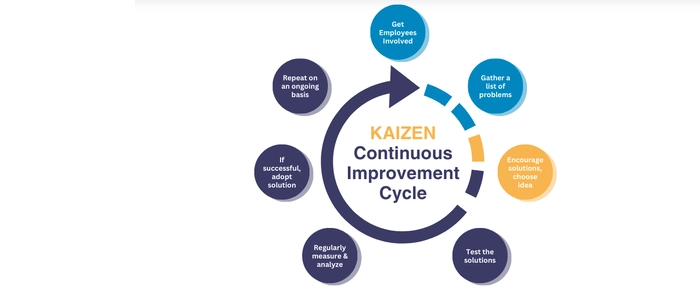
Kaizen improvements typically follow the PDCA cycle:
- Plan – Identify a problem and propose a change
- Do – Test the change on a small scale
- Check – Review results and learn
- Act – Standardize or adjust based on findings
This cycle ensures improvements are structured, measurable, and repeatable.
If you’re new to PDCA, start here: PDCA Cycle Explained (Plan-Do-Check-Act Guide)
How Kaizen Is Measured
Kaizen is not about chasing vanity metrics.
Effective Kaizen measurement focuses on:
- Problem identification and resolution
- Process stability
- Flow and lead time improvement
- Employee participation
Tracking the right indicators matters more than tracking everything.
For guidance, see: Kaizen Metrics: What You Should Track (and Ignore)
Kaizen Is a Culture — Not a Tool
One of the biggest mistakes organizations make is treating Kaizen like a toolkit.
Kaizen succeeds only when:
- Leaders support improvement, not blame
- Problems are seen as opportunities
- Improvement is part of daily work
This distinction is explored here: Lean Culture vs Lean Tools: What Actually Drives Change
Final Thoughts
So, what is Kaizen?
Kaizen is the habit of making work better — one small improvement at a time.
It doesn’t require massive change programs or expensive tools. It requires curiosity, discipline, and a commitment to learning.
When practiced consistently, Kaizen transforms not just processes — but people, teams, and entire organizations.