
Little’s Law Explained: Why Flow Is Predictable
If your team constantly asks, “When will this be done?” you’re not alone. Forecasting in knowledge work feels messy—until you understand one simple relationship that makes flow surprisingly predictable: Little’s Law.
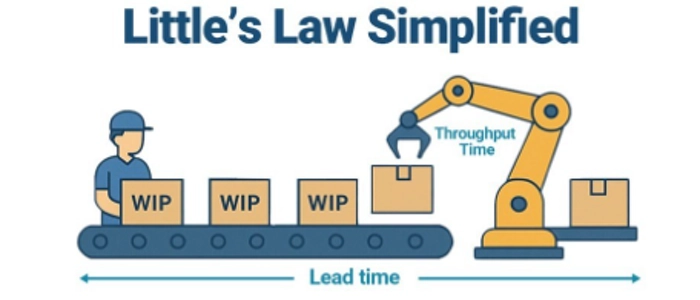
Little’s Law is widely used in operations, manufacturing, and service systems, and it applies beautifully to Agile and Kanban workflows too. It helps you connect three things you already care about:
- Work in Progress (WIP): how much work is currently in the system
- Throughput: how much work you finish per time period
- Lead Time: how long it takes work to finish from start to done
What Is Little’s Law?
Little’s Law:
Lead Time = WIP ÷ Throughput
That’s it. Three variables. One relationship.
It says that in a stable system, the average time it takes for work to flow through your process depends on how much work you have in progress and how quickly you complete work.
Little’s Law in Plain English
Imagine a checkout line:
- If there are more people in line (higher WIP), the wait is longer.
- If the cashier processes more customers per minute (higher throughput), the wait is shorter.
Your Kanban system is a “line” too—except the “people” are tasks, stories, tickets, or requests.
Why Little’s Law Matters for Agile and Kanban Teams
Little’s Law gives you a practical way to:
- Forecast delivery time using real data (not guesses)
- Understand why lead time increases when you overload the system
- Make the case for WIP limits with simple math
- Improve flow predictably by changing the right lever
A Simple Example (With Real Numbers)
Let’s say your team has:
- WIP = 20 items in progress (across all workflow stages)
- Throughput = 5 items finished per week
Using Little’s Law:
Lead Time = 20 ÷ 5 = 4 weeks
So on average, once work starts, it will take about 4 weeks to finish.
Now watch what happens if you reduce WIP to 10 while keeping throughput the same:
Lead Time = 10 ÷ 5 = 2 weeks
Same team. Same throughput. Half the lead time—simply by lowering WIP.
The 3 Levers You Can Pull
1) Reduce WIP (the fastest lever)
Most teams try to go faster by starting more work. That usually backfires.
Reducing WIP:
- cuts multitasking
- reduces queues and waiting
- reveals bottlenecks sooner
- helps teams finish more consistently
If you want shorter lead times, start here.
2) Increase throughput (the sustainable lever)
Throughput improves when you remove friction:
- clearer intake and priority
- smaller batch sizes (break work down)
- fewer handoffs and delays
- faster feedback and review cycles
But remember: pushing throughput with overtime or constant urgency is not sustainable.
3) Stabilize the system (the hidden requirement)
Little’s Law works best when your system is reasonably stable:
- work items are roughly similar in size (or you split large ones)
- you measure consistently (same start and done points)
- you’re not constantly pausing and restarting everything
If your workflow is chaos, start by making work visible and adding basic WIP constraints.
Common Mistakes When Using Little’s Law
Mistake 1: Using “assigned” as the start point
Lead time is most useful when measured from work start (when someone actually begins) to done. If you count from “requested,” your number is mostly waiting time in the backlog, which can distort forecasting.
Mistake 2: Counting WIP incorrectly
WIP means everything currently in the system—not just what one person is working on. Include items in review, testing, blocked states, and waiting for approvals if they’re part of your workflow.
Mistake 3: Ignoring variability
Little’s Law describes averages. Real work varies. Use it as a baseline, then improve predictability by:
- standardizing “ready” criteria
- limiting work size
- reducing blockers and rework
How to Apply Little’s Law to Your Kanban Board
Here’s a simple approach you can run weekly:
- Count WIP: How many items are currently in progress across the board?
- Measure throughput: How many items finished this week?
- Estimate lead time: WIP ÷ throughput
- Pick one improvement: Reduce WIP, shrink work items, or unblock the slowest step
Over time, you’ll see lead time become more stable—and forecasting becomes much easier.
Final Thoughts
Little’s Law is powerful because it’s simple: if you want faster delivery, you either reduce WIP or increase throughput. Most teams can cut lead time dramatically just by stopping the habit of starting too much work at once.
Once you see flow as a system, predictability becomes real—not wishful thinking.
Recommended next reads: