Takt Time vs Throughput: Why They’re Not the Same
Takt time and throughput are two of the most commonly confused flow concepts in Lean and Kanban.
They sound similar because both relate to “how fast work moves.” But they answer different questions — and mixing them up leads to bad planning, overloaded teams, and misleading performance expectations.
Quick Definitions
What is takt time?
Takt time is the pace of customer demand.
It answers: “How often do we need to finish one item to meet demand?”
Example: If customers need 40 orders per day and you have 8 working hours (480 minutes), then:
Takt time = 480 / 40 = 12 minutes per order
So to meet demand, you need to complete one order every 12 minutes (on average).
What is throughput?
Throughput is the actual output rate of your system.
It answers: “How many items do we actually finish per unit of time?”
Example: “We finish 32 orders per day” or “We complete 12 tickets per week.”
The Core Difference
Takt time is a target pace based on demand.
Throughput is the measured pace based on reality.
- Takt time comes from the outside (customer demand).
- Throughput comes from the inside (system capability and constraints).
Why People Mix Them Up
Teams often treat takt time like a productivity metric — as if “takt time = how fast we work.”
But takt time is not what you do. It’s what demand requires.
Throughput is what you actually do.
How to Use Both Together (The Practical Way)
Step 1: Calculate takt time
Use this simple formula:
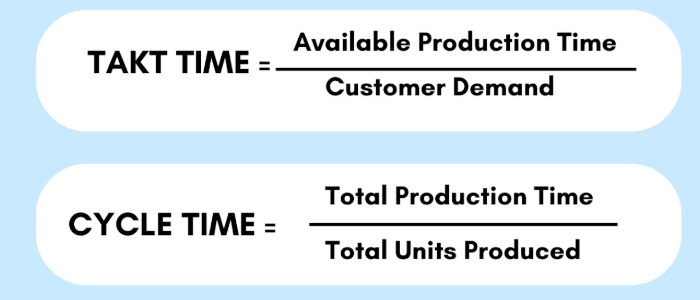
Takt time = Available working time / Customer demand
Make sure “available time” is realistic (exclude breaks, meetings, maintenance, etc.).
Step 2: Measure throughput
Pick a stable time window (daily/weekly) and track completed items.
Throughput examples:
- Orders shipped per day
- Features released per sprint
- Support tickets resolved per week
Step 3: Compare them
This comparison tells you what’s really happening:
- If throughput matches demand (takt pace) → you’re capable of meeting demand consistently.
- If throughput is lower than demand → backlog grows and delays increase.
- If throughput is higher than demand → you may be overproducing, pulling too much work, or creating unnecessary inventory.
Common Scenarios and What They Mean
Scenario A: Takt time is faster than your system can deliver
Example: Demand requires one item every 10 minutes, but you only complete one every 15 minutes.
This means your throughput can’t match demand. You’ll see:
- Rising backlog
- More expedite requests
- Overtime / burnout
- Pressure to “go faster” (often the wrong fix)
The right move is to improve flow (reduce blockers, reduce WIP, improve reliability) or add capacity strategically.
Scenario B: Throughput is high but lead time is still bad
This happens when work is batched, priorities change constantly, or WIP is too high.
You can have decent throughput and still deliver slowly.
That’s why throughput should be paired with lead time and flow metrics — not used alone.
What Takt Time Is NOT
- Not cycle time (how long a step takes)
- Not lead time (how long customers wait)
- Not a “productivity KPI” for individuals
Takt time is a planning signal — not a performance weapon.
How Kanban Teams Can Apply This (Even in Knowledge Work)
Even if you’re not in manufacturing, takt thinking still helps.
You can treat “demand” as:
- Incoming support tickets
- Customer requests
- Sales proposals needed
- Design tasks required
Then compare it to your throughput to understand capacity vs demand — and decide whether to:
- Reduce WIP to improve flow
- Remove bottlenecks
- Rebalance responsibilities
- Adjust intake policies
Related Reading
- Takt Time vs Cycle Time vs Lead Time: Clear Explanation
- Lead Time vs Throughput: Which Metric Should You Track?
- Flow Efficiency: The Metric That Shows True Productivity
- What Is Cycle Time? (Beginner Lean Guide)
- What Is Takt Time? The Simplest Explanation
- Lead Time vs Throughput: Which Metric Should You Track?
Final Thoughts
If you remember one line, remember this:
Takt time is demand pace.
Throughput is delivery pace.
Use takt time to understand what customers require. Use throughput to understand what your system can actually produce. Compare them to make smart decisions about capacity, prioritization, and flow — without guessing.