
What Is Kanban? A Complete Beginner’s Guide
Kanban is one of the simplest — and most misunderstood — ways to manage work.
At its core, Kanban is a visual system designed to help teams see work, limit overload, and improve flow over time.
No complex frameworks. No rigid rules. Just clarity.
What Is Kanban?
Kanban is a visual workflow management method that represents work as it moves through a process.
Work items are displayed on a board, typically moving from left to right through stages such as:
- To Do
- In Progress
- Done
This simple visualization makes work visible to everyone involved.
Why Kanban Works
Most teams struggle not because they work too little — but because they work on too much at once.
Kanban helps teams:
- See all work at a glance
- Identify bottlenecks early
- Reduce multitasking
- Improve predictability over time
When work is visible, problems become visible.
Key Principles of Kanban
Kanban is built on a few core principles:
- Visualize work
- Limit work in progress
- Manage flow
- Make policies explicit
- Improve continuously
These principles allow teams to evolve their process instead of replacing it.
Kanban vs Scrum
Kanban and Scrum are often compared, but they solve different problems.
Scrum focuses on time-boxed iterations and predefined roles.
Kanban focuses on flow and continuous delivery.
For a detailed comparison, read: Kanban vs Scrum: Which One Should Your Team Use?.
What a Kanban Board Looks Like
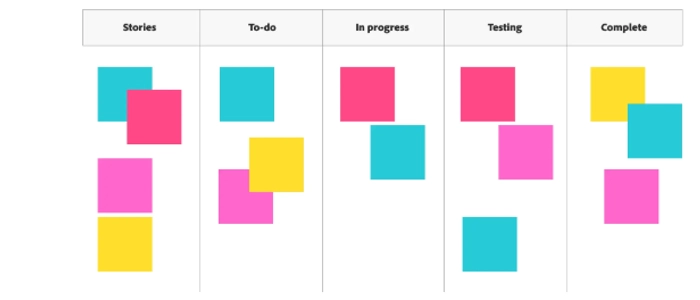
A Kanban board represents your workflow visually.
Each column reflects a step in your process. Each card represents a piece of work.
Over time, teams refine their board to reflect reality instead of ideal plans.
To learn how to create one, see: How to Build a Kanban Board (Step-by-Step).
Why Work-in-Progress Limits Matter
One of Kanban’s most powerful concepts is limiting work in progress.
WIP limits prevent teams from starting too much work and finishing nothing.
They create focus, improve flow, and expose hidden constraints.
Learn more here: What Are WIP Limits? (And Why Most Teams Ignore Them).
Kanban and Visual Project Management
Kanban is a foundational element of visual project management.
Instead of managing work through reports and meetings, teams manage work by seeing it.
This approach reduces friction, misalignment, and unnecessary coordination.
Explore the broader concept in: Visual Project Management: Why Seeing Work Beats Tracking Work.
Who Should Use Kanban?
Kanban works especially well for:
- Knowledge work teams
- Operational workflows
- Support and service teams
- Any environment with changing priorities
If your work arrives unpredictably, Kanban is often a strong fit.
Final Thought
Kanban is not about doing more.
It’s about doing less — better.
When work is visible and limits are respected, teams naturally improve without forcing change.