
Daily Standup Template (Free PDF): 15-Minute Agenda + Blocker Tracker
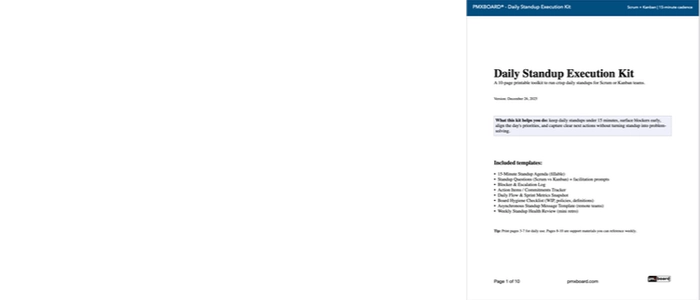
Want a daily standup that stays under 15 minutes and actually improves execution? This free Daily Standup Execution Kit gives you a ready-to-use agenda, Scrum + Kanban prompts, and a blocker log that forces clarity and ownership.
Get the free kit here: Daily Standup Execution Kit (Free PDF)
Why most daily standups fail (even with good teams)
Daily standups drift when they lose their purpose. The goal is not “status reporting.” The goal is alignment + fast blocker removal so work keeps flowing.
- Too much discussion: problem-solving hijacks the meeting.
- No visibility: blockers are mentioned but not tracked.
- No ownership: blockers leave the standup without a clear owner + next step.
- No cadence: there’s no weekly rhythm to review patterns and fix the system.
What you get in the Daily Standup Execution Kit (PDF)
This toolkit is built for Scrum teams, Kanban teams, and hybrid workflows. It’s designed to make the standup repeatable and easy to facilitate.
- 15-minute standup agenda with timeboxes
- Scrum prompts (sprint-aware) + Kanban prompts (flow-focused)
- Blocker log that captures owner, due date, and escalation path
- Action tracker so commitments don’t disappear after the meeting
- Team health + delivery snapshot (quick pulse check)
- Async standup template for remote teams
- Weekly review checklist to improve the system, not just the meeting
Download the free kit: Daily Standup Execution Kit (Free PDF)
The exact 15-minute daily standup format
If you want consistency, keep the format stable. Use this same structure every day, whether you run Scrum or Kanban.
0–2 minutes: start + rules
- Start on time (even if someone is missing).
- Remind: no problem-solving in the standup.
- Confirm the board is visible (physical or digital).
2–12 minutes: updates (Scrum or Kanban prompts)
Scrum-style prompts (use if you run sprints):
- What did I complete since yesterday?
- What will I complete today?
- What is blocking me?
Kanban-style prompts (use if you run flow):
- What work is closest to “Done” and needs help?
- What’s stuck in progress and why?
- Are we violating WIP limits or pulling too much?
If your team debates Scrum vs Kanban often, this comparison helps: Kanban vs Scrum: Which One Should Your Team Use?
12–15 minutes: blocker triage (the part most teams skip)
This is where execution improves. For each blocker:
- Write it down (don’t rely on memory).
- Assign an owner (one person accountable).
- Define the next step (one action, not a vague intention).
- Schedule follow-up (right after standup or async with a deadline).
How to handle blockers without turning the standup into a workshop
The standup is for surfacing blockers, not solving them. The fix is a short follow-up huddle with only the relevant people.
- Capture: log the blocker in the moment.
- Contain: move discussion to a follow-up.
- Close: confirm owner + due date + escalation path.
If you want a deeper guide to standup facilitation, this article is already in your ecosystem: Daily Standups: How to Run Daily Meetings That Don’t Waste Time
Best-practice standup rules (keep it sustainable)
- 15 minutes max: start on time, end on time.
- No problem-solving: capture issues and handle them after the standup.
- Blockers must have an owner: assign a next step before you move on.
- Follow-up is scheduled: quick huddle immediately after, or async with a deadline.
FAQ
Is this daily standup template for Scrum or Kanban?
Both. The kit includes prompts and optional fields for Scrum teams (sprint context) and Kanban teams (flow-based prompts).
What are the best daily scrum questions?
The classic three questions work well for Scrum. If you want more detail and variations, this guide may help: How to Run a Daily Scrum (Standup) That Actually Works
How long should a daily standup be?
Most high-performing teams keep it to 10–15 minutes. The goal is alignment and blocker visibility—not deep discussion.
How should we handle blockers?
Capture blockers during the standup, assign an owner, and move problem-solving to a short follow-up huddle or async thread. The kit includes a blocker log and escalation workflow to make this easy.
Do you email spam?
No. We use your email to deliver the kit and occasional Agile/project execution resources. Unsubscribe anytime.
Get the Daily Standup Execution Kit (Free PDF)
If you want a repeatable 15-minute standup that works for Scrum, Kanban, and hybrid teams, grab the kit here: