What Is Scrum? A Complete Beginner’s Overview
If you’re new to Agile, you’ve probably heard the word Scrum used everywhere — but what is Scrum, really? Is it a framework, a process, or just another project management buzzword?
Scrum is a lightweight Agile framework designed to help teams deliver complex work in small, valuable increments. It focuses on collaboration, adaptability, and continuous improvement — making it one of the most widely used Agile approaches in the world.
This beginner-friendly guide explains Scrum in plain language: how it works, why teams use it, and what you need to know to get started.
What Is Scrum?
Scrum is an Agile framework used to manage complex work by breaking it into short, repeatable cycles called sprints. Instead of planning everything upfront, Scrum teams learn through doing — inspecting results frequently and adapting as they go.
Scrum is not a rigid process or step-by-step methodology. It provides a simple structure that helps teams:
- Deliver value faster
- Respond to change effectively
- Improve collaboration and transparency
- Continuously learn and adapt
Although Scrum originated in software development, it’s now used in marketing, product development, operations, education, and even personal productivity.
The Core Idea Behind Scrum
Scrum is built on one fundamental belief: complex work cannot be fully planned in advance.
Instead of detailed long-term plans, Scrum relies on:
- Short feedback loops
- Frequent inspection of progress
- Continuous adaptation based on real results
This makes Scrum especially effective in environments where requirements change, uncertainty is high, or learning is essential.
The Three Scrum Roles
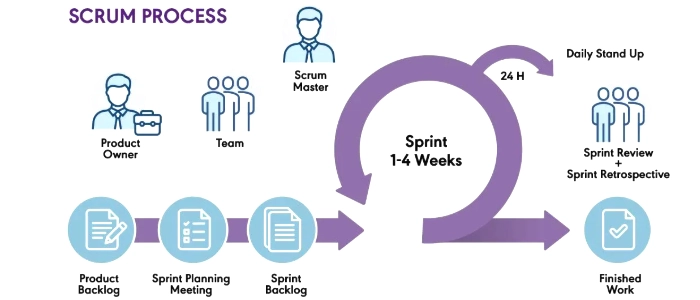
Scrum defines three clear roles, each with specific responsibilities. Together, they form the Scrum Team.
1. Product Owner
The Product Owner is responsible for maximizing the value of the product. They:
- Define and prioritize the product backlog
- Clarify requirements and acceptance criteria
- Represent customer and stakeholder interests
2. Scrum Master
The Scrum Master acts as a servant-leader and coach. Their role is to:
- Ensure Scrum is understood and used correctly
- Remove obstacles that block the team
- Facilitate Scrum events
3. Development Team
The Development Team (often just called “the team”) is responsible for delivering the work. They are:
- Cross-functional
- Self-organizing
- Accountable for delivering usable increments
For a deeper dive, see: Scrum Roles Explained: Who Does What on an Agile Team?
The Five Scrum Ceremonies (Events)
Scrum uses five recurring events to create rhythm, alignment, and continuous improvement.
1. Sprint
A sprint is a fixed-length timebox (usually 1–4 weeks) during which the team delivers a usable increment of work.
2. Sprint Planning
The team decides what work will be completed during the sprint and how it will be done.
Learn more here: Sprint Planning Guide: How to Run a High-Impact Sprint
3. Daily Scrum
A short daily meeting where the team synchronizes work and identifies blockers.
4. Sprint Review
The team demonstrates completed work and gathers feedback from stakeholders.
5. Sprint Retrospective
The team reflects on how they worked and identifies improvements for the next sprint.
Full breakdown here: Scrum Ceremonies Explained: When and How They Work
Scrum Artifacts (What Scrum Produces)
Scrum has three main artifacts that provide transparency and focus.
- Product Backlog: Ordered list of everything that might be needed in the product
- Sprint Backlog: Selected backlog items for the current sprint
- Increment: The usable result delivered at the end of each sprint
These artifacts help teams track progress, align priorities, and measure outcomes.
What Is a Scrum Board?
A Scrum board is a visual tool used to track work during a sprint. It typically includes columns such as:
- To Do
- In Progress
- Done
Unlike Kanban boards, Scrum boards usually reset at the start of each sprint.
Beginner walkthrough here: What Is a Scrum Board? Full Walkthrough for Beginners
How Scrum Estimates Work (Story Points vs Hours)
Scrum teams typically estimate work using story points instead of hours. This shifts focus from time prediction to relative effort and complexity.
Learn the difference here: Story Points vs Hours: Which Should Your Team Use?
Scrum vs Other Approaches
Scrum is not the only Agile framework. Understanding how it compares to others helps teams choose wisely.
- Kanban vs Scrum: Which One Should Your Team Use?
- Agile vs Waterfall: Which Method Is Right for Your Project?
If you’re designing a broader system beyond Scrum alone, this guide helps: How to Build an Agile Team Operating System
Is Scrum Right for You?
Scrum works best when:
- Work is complex and uncertain
- Fast feedback is valuable
- Teams can collaborate closely
- Continuous improvement is encouraged
If your work is highly repetitive or predictable, other approaches (like Kanban) may be a better fit.
Final Thoughts
Scrum is not a silver bullet — but when used correctly, it creates clarity, focus, and momentum in complex work environments.
By understanding Scrum roles, ceremonies, artifacts, and mindset, you give your team a shared language for collaboration and improvement.
Start simple. Inspect often. Adapt continuously. That’s Scrum.