
What Is Kanban? A Complete Beginner’s Guide
Kanban is one of the simplest—and most powerful—ways to manage work. Whether you’re running manufacturing operations, product development, software delivery, or day-to-day business tasks, Kanban helps you see work clearly, spot problems early, and improve flow without adding complexity.
If you want a team that delivers faster, makes better decisions, and removes daily guesswork, Kanban is a proven starting point.
What Is Kanban?
Kanban is a visual method for managing work as it moves through a process. It helps teams limit overload, improve predictability, and continuously improve by making the workflow visible.
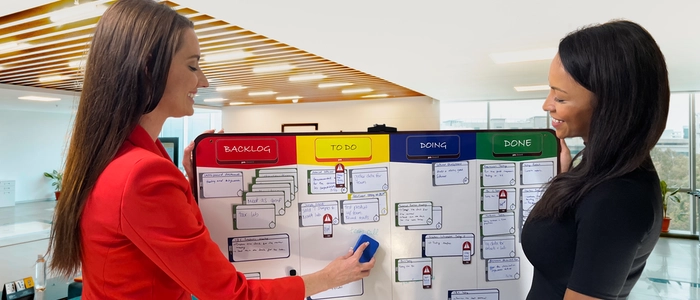
Most teams practice Kanban using a Kanban board (columns + cards) to show what’s waiting, what’s in progress, and what’s done. If you want a practical next step, start here: What Are WIP Limits? (And Why Most Teams Ignore Them).
How Kanban Works (In Plain English)
Kanban works by combining three practical ideas:
- Visualize the workflow (so issues can’t hide)
- Limit work in progress (so work finishes instead of stacking up)
- Improve flow (so delivery becomes smoother and more predictable)
That’s why Kanban is often paired with metrics like Flow Efficiency Formula (Explained So Anyone Can Use It)—to reveal how much time work is actually being worked on versus waiting.
The Core Components of Kanban
1) A Visual Board (Workflow Stages)
Each column represents a stage of work (for example: “Ready,” “Design,” “Build,” “Review,” “Done”). The goal isn’t to make the board look busy—it’s to make the workflow clear.
2) Cards (Work Items)
Cards represent tasks, requests, features, defects, or process steps. Done well, cards are specific and easy to understand. If you want to strengthen how your team uses measurement to improve card flow, see: Kanban Metrics: What to Track and Why.
3) WIP Limits (The “Stop Starting, Start Finishing” Rule)
WIP limits cap how many items can be “in progress” at once. This prevents overload, reduces context switching, and forces teams to finish work before pulling more in.
Learn the basics here: What Are WIP Limits? (And Why Most Teams Ignore Them).
4) Flow Metrics (How You Know It’s Working)
Kanban becomes powerful when you measure what matters. Metrics like throughput, cycle time, and flow efficiency help you improve delivery without guessing.
Start with: Flow Efficiency Formula (Explained So Anyone Can Use It).
Why Kanban Works (The Real Benefits)
Kanban works because it makes invisible problems visible. A Kanban system helps teams:
- Prevent overload and constant firefighting
- Improve communication and coordination
- Expose bottlenecks and stuck work quickly
- Reduce delays and waiting time
- Create more predictable delivery
- Align work with actual capacity
In practice, Kanban is a form of Visual Project Management: Why Seeing Work Beats Tracking Work—because seeing the workflow changes the conversation from opinions to facts.
Swimlanes and Team Clarity (Optional but Powerful)
As work grows, many teams add swimlanes to separate work by class of service, team, customer, or priority. If you want a clear visual explanation of why visibility improves coordination, start here: Visual Workflows: How Seeing Work Improves Decision Making.
Common Kanban Mistakes (and How to Avoid Them)
1) Too Much Work in Progress
The board becomes cluttered and nothing finishes. This is the #1 failure mode. Fix it with: What Are WIP Limits? (And Why Most Teams Ignore Them).
2) No Clear Workflow Definition
If “In Progress” means ten different things, the board won’t reveal problems. Define stages so cards move in a consistent way.
3) Treating Kanban Like a Task List
Kanban isn’t just a visual to-do list—it’s a system for managing flow. If the board doesn’t change how work moves, it’s not Kanban yet.
4) Not Connecting Kanban to Improvement
Kanban should highlight what to improve next. Many teams connect Kanban insights to broader improvement systems like Lean and Kaizen. A good starting point is: Kaizen vs Lean: What’s the Difference?.
Kanban and Process Improvement
Kanban isn’t only for knowledge work—it’s a practical bridge into continuous improvement. Once your workflow is visible, you can identify delays, handoffs, and friction points that are often hidden in spreadsheets.
If you want to zoom out and see the end-to-end process, Kanban pairs well with: What Is Value Stream Mapping? (Beginner Guide).
Final Thoughts
Kanban helps teams see work clearly, reduce overload, and improve delivery—without adding heavy process overhead. Start simple: visualize the workflow, set WIP limits, and improve flow one constraint at a time.
Product Tie-In — PMXBOARD Kanban Board Set
If you want a premium, ready-to-use Kanban system for your team, PMXBOARD’s Kanban Board Set gives you:
- Modular magnetic workflow stages
- Durable, professional visual design
- Reusable magnetic cards
- Status indicators
- A scalable layout for any team size
It’s designed for teams who want a clear, physical, high-impact visual system—not just another software board.