
What Is Value Stream Mapping? (Beginner Guide)
You can’t improve a process you can’t see.
That’s the core idea behind Value Stream Mapping (VSM). It is a visual method used to understand how work actually flows — from request to delivery — and to identify waste, delays, and inefficiencies hiding inside everyday processes.
This guide explains Value Stream Mapping in simple terms, shows when to use it, and helps you understand why it’s one of the most powerful tools in Lean and Kaizen.
What Is Value Stream Mapping?
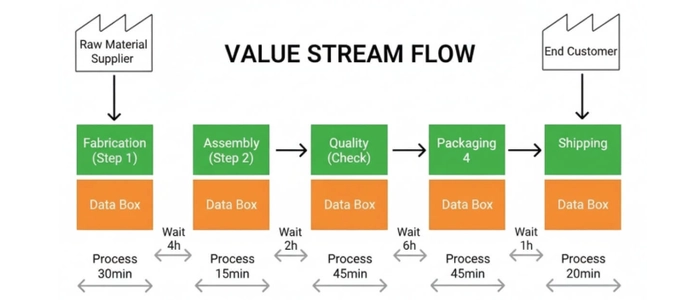
Value Stream Mapping is a visual technique used to map every step required to deliver a product or service. It shows:
- What steps exist in the process
- How information flows between steps
- Where time is spent working vs waiting
- Where waste and bottlenecks occur
A value stream includes all actions — both value-adding and non-value-adding — required to move work from start to finish.
Why Value Stream Mapping Matters
Most teams try to improve performance by working harder or adding more tools. VSM takes a different approach: it improves performance by removing friction.
When teams visualize the full process, they often discover:
- Long wait times between steps
- Rework caused by unclear inputs
- Unnecessary handoffs and approvals
- Work piling up instead of flowing
These issues are rarely visible in task lists or dashboards — but they become obvious on a value stream map.
One of the most common outcomes of VSM is realizing that the system is constrained by a few points of delay. If you want a practical guide to identifying and fixing those constraints, start here: Bottlenecks: How to Identify and Remove Them.
Current State vs Future State Mapping
Current State Map
The current state map documents how work actually flows today — not how it’s supposed to flow.
This step is critical. Skipping it leads to “solution-first” thinking and missed root causes.
Future State Map
The future state map shows how the process should flow after improvements are applied. It becomes a shared vision for change and a blueprint for action.
The gap between current and future state defines your improvement roadmap.
Once you can see the gap clearly, the next step is turning insights into a structured improvement plan. This step-by-step guide walks you through that process: Value Stream Analysis: A Step-by-Step Beginner Guide.
What Problems Does Value Stream Mapping Solve?
Value Stream Mapping is especially effective when teams struggle with:
- Long lead times
- Unclear ownership between departments
- Too much work-in-progress
- Frequent delays and firefighting
Many of these problems are caused by waste. If you’re not familiar with waste categories, start here: 8 Wastes of Lean: How to Find and Remove Them.
How Value Stream Mapping Connects to Kaizen
VSM is not a one-time exercise. It is often the foundation for Kaizen events and continuous improvement efforts.
Teams use value stream maps to:
- Select improvement opportunities
- Prioritize actions with the highest impact
- Align stakeholders on what to fix first
This is why Value Stream Mapping is frequently used at the start of a Kaizen event. If you’re new to Kaizen, this guide provides helpful context: What Is Kaizen? A Beginner’s Guide to Continuous Improvement.
Common Mistakes Beginners Make
- Mapping only one department instead of the full flow
- Ignoring information flow and approvals
- Focusing on tools instead of flow
- Creating a map without turning it into actions
Value Stream Mapping is only useful when it leads to change. That’s why it’s often paired with structured improvement planning.
When Should You Use Value Stream Mapping?
VSM is most effective when:
- You need to improve lead time or delivery speed
- Multiple teams or roles are involved in a process
- Problems repeat despite local optimizations
Value Stream Mapping Is About Seeing the System
Value Stream Mapping shifts the conversation from “who is busy” to “where work gets stuck.”
By making the entire system visible, teams can stop guessing, stop blaming, and start improving with clarity.
You don’t need perfection to start. You just need visibility.