Kanban vs Agile: What’s the Difference?
If you’ve ever heard someone say “We do Agile, so we use Kanban,” you’re not alone.
Kanban and Agile are closely related—but they’re not the same thing. One is a specific method. The other is a broader mindset and family of approaches.
In this guide, we’ll clear up the confusion in a practical way: what Agile means, what Kanban is, how they overlap, and how to choose the right approach for your team (or your personal workflow).
Agile vs Kanban in One Sentence
- Agile is a mindset and set of values for delivering work in a flexible, iterative way.
- Kanban is a visual workflow method that helps you manage work by limiting WIP and improving flow.
So: Kanban can be Agile—but Agile is bigger than Kanban.
What Is Agile?
Agile is an approach to managing work that emphasizes:
- delivering value in small increments
- adapting quickly to change
- continuous learning and improvement
- collaboration and transparency
Agile shows up in many frameworks and methods—like Scrum, Kanban, XP, and hybrid systems.
What Is Kanban?
Kanban is a method for managing work as a flow system. The core practices are simple and powerful:
- visualize the workflow (board + columns)
- limit work in progress (WIP)
- manage flow (reduce delays, remove bottlenecks)
- make policies explicit (clear rules for how work moves)
- improve continuously
Kanban can be used by teams or individuals and works especially well when priorities change frequently or work arrives continuously.
How Kanban Fits Inside Agile
Think of Agile as an umbrella.
Under that umbrella are multiple ways to practice Agile. Kanban is one of them because it supports Agile values like transparency, adaptability, and continuous improvement—without requiring strict timeboxed cycles.
Key Differences: Kanban vs “Agile Frameworks”
1) Timeboxing vs continuous flow
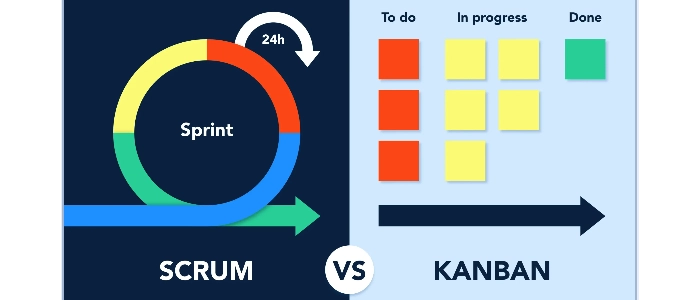
- Many Agile frameworks (like Scrum) use timeboxed sprints.
- Kanban typically uses continuous flow: work moves when capacity is available.
2) Roles and ceremonies
- Scrum includes defined roles and ceremonies (planning, daily scrum, review, retro).
- Kanban does not require specific roles or ceremonies (though you can add them).
3) How work is planned
- Scrum plans a sprint backlog and commits to a sprint goal.
- Kanban focuses on pulling the next highest-priority work when WIP allows.
4) Change tolerance
- Scrum discourages changing sprint scope mid-sprint.
- Kanban is designed for changing priorities and ongoing intake.
When Kanban Is the Better Choice
Kanban tends to win when:
- work arrives unpredictably (support, ops, marketing requests)
- priorities shift often
- your team struggles with too much WIP and constant context switching
- you want a lightweight system you can implement fast
When a Scrum-Style Agile Framework Is the Better Choice
A timeboxed framework like Scrum can be a stronger fit when:
- you need structured planning cycles and sprint goals
- you’re building a product with larger features and clear increments
- your team benefits from predictable cadence and ceremonies
- you want strong feedback loops on a recurring schedule
The Most Common (and Best) Reality: Hybrid
Many teams blend approaches:
- use Kanban visualization + WIP limits
- keep Sprint planning or a weekly cadence
- run retrospectives for continuous improvement
That’s still Agile—as long as the system helps you learn, adapt, and deliver value consistently.
Recommended Reading
Same-category links (as provided):
- Kanban vs Scrum: Which One Should Your Team Use?
- Kanban vs Agile: What’s the Difference?
- Scrum vs Kanban: Which Method Is Right for Your Project?
- How to Choose Between Scrum and Kanban (Real Examples)
- What Is a Scrum Board? Full Walkthrough for Beginners
Cross-category links (as provided):
- Kanban vs Scrum: Which One Should Your Team Use?
- How to Choose Between Scrum and Kanban (Real Examples)
- What Is Scrum? A Complete Beginner’s Overview
Final Thoughts
Agile is the philosophy. Kanban is one method you can use to practice it.
If you want a simple way to visualize work, reduce overload, and improve flow, Kanban is often the fastest path to real results. If you need structured iteration and a predictable cadence, a Scrum-style framework may fit better.
Either way, the goal is the same: deliver value, learn fast, and improve continuously.