
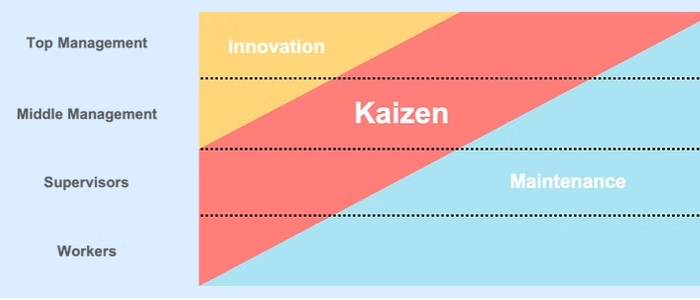
Kaizen vs Innovation: Why Continuous Beats Occasional
Most teams say they want innovation — but what they really need first is consistency.
Innovation can create breakthroughs. But without a daily habit of improvement, those breakthroughs fade, processes drift, and performance becomes unpredictable.
That’s where Kaizen wins: it builds an operating system for progress — not just a moment of change.
Kaizen vs Innovation: What’s the Difference?
What Kaizen means (simple definition)
Kaizen is continuous improvement through small, frequent changes made by the people doing the work. It focuses on:
- Reducing waste and friction
- Standardizing what works
- Improving quality and flow over time
- Building better habits and systems
What innovation means (simple definition)
Innovation is a meaningful step-change — a new idea, product, technology, or approach that creates a major improvement. Innovation often looks like:
- New tools or automation
- New products or services
- New business models or methods
- Big redesigns or transformations
In short: Kaizen improves what exists. Innovation creates something new (or changes the game).
Why Continuous Improvement Usually Beats Occasional Innovation
Here’s the truth: most organizations don’t fail because they lack ideas. They fail because they can’t execute consistently.
1) Kaizen creates compounding gains
Small improvements done daily are powerful because they compound. When teams remove a little waste each week, performance gets better without needing dramatic overhauls.
2) Kaizen builds stability — the foundation for innovation
Breakthroughs require a stable process to scale. If the core workflow is chaotic, innovation becomes an expensive experiment that never sticks.
Kaizen strengthens the “engine room” first — so innovation has a reliable platform to launch from.
3) Innovation without Kaizen creates “change spikes”
Many teams innovate in bursts:
- Big project launches
- Major process redesigns
- New tools adopted quickly
Then reality sets in: training gaps, inconsistent adoption, and workarounds creep in. The system drifts back toward old habits.
Kaizen prevents that by making improvement a routine — not a rare event.
4) Kaizen is accessible to everyone
Innovation often depends on a few specialists, budgets, or executive sponsorship. Kaizen depends on participation.
When frontline teams are empowered to improve work, you unlock thousands of small insights that leadership would never see from the top.
5) Kaizen makes problems visible early
Continuous improvement creates a culture where teams surface issues quickly — before they become expensive. That alone can outperform “innovative” solutions that arrive too late.
But Innovation Still Matters
To be clear: this isn’t “Kaizen instead of innovation.” It’s Kaizen before (and alongside) innovation.
Here’s a healthy way to view it:
- Kaizen keeps the system improving every day
- Innovation creates strategic leaps when needed
The best teams run both — but Kaizen prevents innovation from becoming fragile.
When to Use Kaizen vs When to Use Innovation
Use Kaizen when…
- You have repeatable work with waste, delays, or quality issues
- Performance is inconsistent and you need stability
- Small changes can produce measurable gains
- You need the team to own the improvements
Use innovation when…
- The current system has hit a hard limit
- A new market, customer need, or technology changes the rules
- You need a step-change in capability (not just efficiency)
- Competitive pressure demands a new approach
How to Build a “Kaizen Engine” That Makes Innovation Stronger
1) Make performance visible
Continuous improvement starts when teams can see results daily — not just monthly.
That’s why visual KPI tracking and daily management are so effective: they create a shared reality and highlight gaps immediately.
2) Create a daily improvement cadence
Keep it simple:
- Short daily or weekly review of KPIs
- Identify one obstacle or waste to remove
- Assign a clear owner and next step
- Follow through and standardize what works
3) Separate “small improvement” from “big bets”
Kaizen should not get blocked waiting for innovation budgets. And innovation should not distract teams from daily improvement.
Run two lanes:
- Kaizen lane: quick wins, small experiments, immediate learning
- Innovation lane: strategic projects, pilots, step-change initiatives
4) Standardize improvements so they stick
Kaizen only works when gains become the new baseline. When something improves:
- Update the standard
- Train the team
- Make it visible on the board
- Check it regularly
How Visual Management Makes Kaizen (and Innovation) Work in Real Life
Kaizen is not a philosophy you “believe in.” It’s a system you run.
Visual management tools help teams run that system by making work, priorities, and results obvious at a glance — so improvement becomes natural.
Related Reading
- KPI Boards: How to Track What Actually Matters
- Visual Management Boards: Examples & Templates
- How to Use Visual KPIs for Daily Leadership
- Daily Management Boards: How Leaders Stay Aligned
- Visual Project Management: Why Seeing Work Beats Tracking Work
- Heijunka Explained: How Level Loading Reduces Chaos
- What Is a Pull System? (Beginner-Friendly)
- What Is Takt Time? The Simplest Explanation
Final Thoughts
Innovation can change the direction of a business — but Kaizen changes the trajectory of daily execution.
If you want progress that lasts, build a continuous improvement system first. Then, when innovation happens, your team has the stability, visibility, and habits to make it stick.