
What Is Root Cause Analysis? (Beginner Guide)
Root Cause Analysis (RCA) is one of the most important skills in continuous improvement — yet it’s also one of the most misunderstood.
Many teams are busy fixing problems every day, but the same issues keep coming back. That’s usually a sign that they’re treating symptoms, not causes. Root cause analysis helps you break that cycle by identifying why a problem truly happens — and how to prevent it from happening again.
What Is Root Cause Analysis?
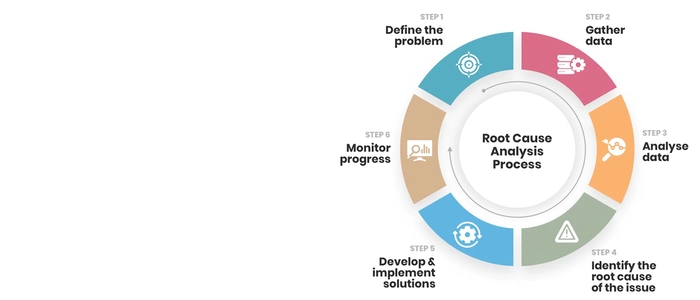
Root Cause Analysis is a structured approach used to identify the underlying causes of a problem rather than just addressing its immediate effects.
The goal of RCA is simple:
- Understand why a problem occurred
- Fix the system that allowed it to happen
- Prevent recurrence — not just temporary relief
Instead of asking “Who made the mistake?” RCA asks, “What in the process allowed this to happen?”
Root Cause vs Symptom (Why This Matters)
A symptom is what you see. A root cause is why it exists.
Example:
- Symptom: Orders are shipped late
- Quick fix: Ask people to work faster or add overtime
- Root cause: Poor prioritization, unclear workflows, or overloaded work-in-progress
When teams only fix symptoms, problems return — often worse than before. To build a deeper mindset around this, see Root Cause vs Symptom: How to Think Like an Improver.
When Should You Use Root Cause Analysis?
RCA is most valuable when problems:
- Keep repeating
- Have a high impact on quality, safety, cost, or delivery
- Are complex or cross-functional
- Can’t be solved with a quick adjustment
You don’t need RCA for every minor issue — but for persistent or high-impact problems, it’s essential.
The Core Principles of Root Cause Analysis
1. Focus on Systems, Not People
Most problems are caused by weak processes, unclear standards, or poor system design — not bad intentions.
2. Ask “Why” Multiple Times
The first answer is rarely the root cause. Deeper understanding comes from disciplined questioning.
3. Use Evidence, Not Assumptions
RCA relies on facts, data, and observation — not opinions.
4. Fix the Cause, Not the Outcome
True improvement removes the condition that created the problem in the first place.
Common Root Cause Analysis Methods
1. 5 Whys
The 5 Whys technique is one of the simplest and most widely used RCA methods. You repeatedly ask “Why?” until you reach a cause that is within your control to fix.
Example:
- Why was the report late? → Because data wasn’t ready
- Why wasn’t data ready? → Because updates weren’t submitted on time
- Why weren’t updates submitted? → Because responsibilities weren’t clear
- Why weren’t responsibilities clear? → Because there’s no standard process
Learn how to apply this properly in 5 Whys Problem Solving: How to Get to the Real Cause.
2. PDCA (Plan–Do–Check–Act)
PDCA is a structured learning cycle that pairs naturally with RCA. Once you identify a likely root cause, PDCA helps you test and validate countermeasures.
- Plan: Identify the problem and root cause
- Do: Test a solution
- Check: Evaluate results
- Act: Standardize or adjust
See PDCA Cycle Explained (Plan-Do-Check-Act Guide) for a full walkthrough.
3. A3 Problem Solving
A3 is a structured, visual approach to problem solving that includes problem definition, root cause analysis, countermeasures, and follow-up — all on a single page.
A3 is ideal for:
- Cross-functional problems
- Issues with multiple contributing causes
- Problems that require leadership alignment
Learn the full structure in A3 Problem Solving: Step-by-Step Beginner Guide.
Root Cause Analysis and Waste Reduction
Many recurring problems are actually forms of waste — delays, rework, defects, overprocessing, or waiting.
RCA helps expose why that waste exists so it can be removed permanently. For context, see What Is Process Waste? (Beginner-Friendly Lean Guide).
Root Cause Analysis in Offices and Knowledge Work
RCA isn’t just for factories. In offices, root causes often hide in:
- Unclear ownership
- Too many handoffs
- Poor visual management
- Hidden work and priorities
Applying RCA alongside workplace organization can be especially powerful. See 5S in Offices: Practical Examples for Knowledge Teams.
Common Mistakes in Root Cause Analysis
Stopping Too Early
The first “why” is rarely the root cause.
Blaming Individuals
People work within systems. Fix the system.
Jumping to Solutions
Solutions without understanding often create new problems.
Not Following Up
If you don’t verify effectiveness, the problem may return.
How Root Cause Analysis Builds Lean Culture
Organizations that consistently practice RCA develop a culture of learning instead of blame. Problems become opportunities for improvement, not firefights.
This mindset shift is critical to sustainable Lean transformation. Explore this further in Lean Culture vs Lean Tools: What Actually Drives Change.
Final Thoughts
Root cause analysis is not about being perfect — it’s about being curious, disciplined, and honest about how work really happens.
When teams learn to identify and remove root causes, they stop chasing problems and start building stable, reliable systems that improve over time.
Product Tie-In — PMXBOARD Kaizen Board Set
Root cause analysis works best when problems, causes, and actions are visible to the whole team. PMXBOARD’s Kaizen Board Set is designed to support structured RCA, A3 thinking, and PDCA cycles — helping teams move from recurring issues to sustained improvement.