
What Is Yokoten? How Great Teams Share Improvement
One team fixes a problem. Results improve. Everyone celebrates.
Then… nothing changes anywhere else.
That’s one of the most common failure patterns in continuous improvement: great ideas don’t spread. Yokoten is the Lean concept designed to solve that.
What Does Yokoten Mean?
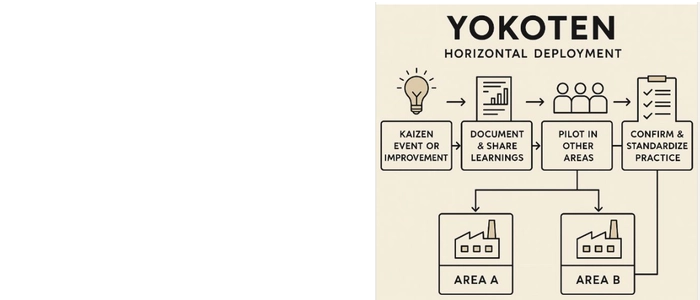
Yokoten (often translated as “horizontal deployment”) means sharing and spreading improvements across teams so that learning doesn’t stay isolated in one area.
Instead of each team reinventing the wheel, Yokoten helps organizations copy what works, adapt it intelligently, and scale better outcomes.
Why Improvements Don’t Naturally Spread
Even when an improvement is clearly successful, it often stays local because:
- People don’t know it happened (no visibility)
- It’s not documented clearly (hard to replicate)
- Teams are too busy (no time to review or adopt)
- Contexts differ (teams assume “that won’t work here”)
- Ownership is unclear (no one is responsible for spreading it)
Yokoten creates a structured way to overcome these barriers.
Yokoten vs “Best Practices”
Yokoten is not a top-down memo that says “do this now.”
It’s a learning process: share the problem, the change, the result, and the conditions — then help other teams adapt and implement it.
In other words: Yokoten spreads learning, not just instructions.
When Yokoten Matters Most
Yokoten is especially powerful when:
- Multiple teams do similar work (support, engineering, operations, sales)
- Recurring issues appear across departments
- You want consistent customer experience across locations
- You’re trying to stabilize flow and delivery predictability
A Simple Yokoten Framework
Step 1: Capture the improvement clearly
Don’t just share “we improved quality.” Capture:
- Problem: What was happening?
- Root cause: Why was it happening?
- Change: What did you implement?
- Before/After: What did the metrics show?
- Conditions: What made it work here?
If you can’t explain it in a short summary, it won’t spread.
Step 2: Identify “where else this applies”
List teams, projects, or processes with similar patterns. Ask:
- Who has the same bottleneck?
- Where do we see similar delays or queues?
- Which teams track the same metric?
Step 3: Share through a visible system (not a private message)
Yokoten fails when it lives in hidden chat threads.
Use a visible place: a team board, a learning log, a shared improvement wall, or a recurring review. Make it easy for others to discover and revisit.
Step 4: Adapt — don’t copy blindly
Some improvements can be copied directly. Many require a small adjustment due to different constraints.
A good Yokoten question is: “What part stays the same, and what must change for our context?”
Step 5: Verify impact with a simple metric
If you spread an improvement but don’t check results, it becomes “busywork.”
Pick one outcome metric (lead time, defect rate, throughput, rework) and confirm the change actually helped.
Step 6: Turn it into a repeatable pattern
Once you’ve spread a few improvements successfully, standardize the process:
- How improvements are documented
- Where they are posted
- How often teams review them
- Who owns follow-up
This is how Yokoten becomes culture — not a one-time initiative.
How Yokoten Improves Flow (Not Just “Sharing”)
When teams spread improvements, they reduce variation between departments. That creates smoother flow across the organization.
That’s why Yokoten connects naturally to flow metrics like lead time, cycle time, and throughput: consistency improves predictability.
Related Reading
- Little’s Law Explained: Why Flow Is Predictable
- Flow Efficiency Formula (Explained So Anyone Can Use It)
- Lead Time vs Throughput: Which Metric Should You Track?
- What Is Cycle Time? (Beginner Lean Guide)
- Kanban Metrics That Actually Matter (And Which Don’t)
- What Makes a Good Kanban Board? (Real Examples)
- Kanban Board Examples from Real Teams
Final Thoughts
Continuous improvement isn’t just about making one team better. It’s about making the whole system better.
Yokoten is how great organizations scale learning: capture what worked, share it visibly, adapt it thoughtfully, and verify results.
When you do Yokoten well, improvement stops being isolated wins — and becomes organizational momentum.